

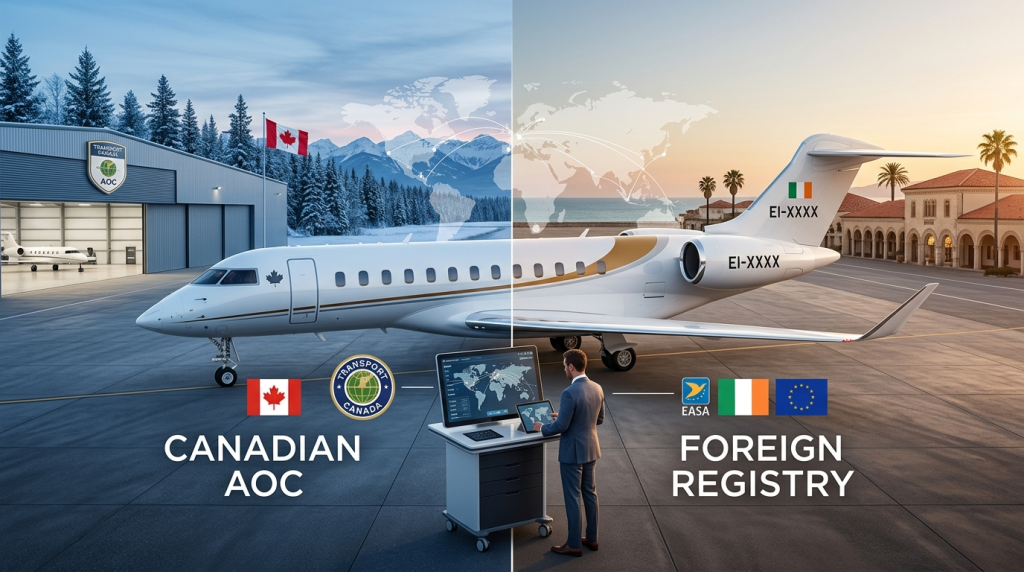
You have just taken ownership of a business jet. The aircraft is ready, the crew is selected, and your travel schedule is already demanding flexibility across multiple continents. Then comes a question that surprises many first-time aircraft owners: where, exactly, should your aircraft be registered — and does it matter?
It matters considerably. The country of registration determines which regulatory authority oversees your aircraft, which air operator certificate governs its commercial operations, and which international agreements protect your asset. For owners operating through Canada, the choice between Canadian aircraft registration and a foreign registry is one of the most consequential structural decisions in the ownership journey.
This article breaks down what each path involves, where the genuine differences lie, and what owners should weigh before making that decision.
What Canadian Aircraft Registration Actually Means
Canadian aircraft registration assigns your aircraft a C-prefix tail number and places it under the jurisdiction of Transport Canada, the federal department responsible for civil aviation regulation in Canada. To operate that aircraft commercially — including charter flights, revenue operations, or managed operations on behalf of the owner — the managing operator must hold a Canadian Air Operator Certificate, commonly referred to as an AOC.
The AOC is not a registration mark. It is an authorization issued by Transport Canada confirming that the operator has the qualified crew, maintenance programs, safety systems, and operational infrastructure to conduct commercial air operations. Without a valid AOC, a C-registered aircraft cannot legally conduct commercial flights.
For owners whose operations are primarily domestic or North American, Canadian aircraft registration offers a straightforward and well-understood regulatory framework. Transport Canada is internationally respected, and C-registered aircraft are routinely accepted across North American airspace without additional permit requirements.
Where Foreign Registries Create Opportunity — and Complexity
Not every aircraft owner operates primarily within Canada. Business jet ownership increasingly means intercontinental travel: Europe one week, the Middle East the next, Southeast Asia the following month. For these ownership profiles, the aircraft’s country of registration by country shapes every operational and regulatory interaction along the route.
The European Question
Aircraft registered outside EASA member states must typically obtain individual permits for certain EU operations — an administrative layer that adds time and complexity to scheduling. Irish-registered aircraft, operating under EASA oversight, can conduct commercial operations throughout the EU and domestically within the United Kingdom without those restrictions. For owners with heavy European routing, that operational freedom is a material structural advantage.
The AOC Connection
Foreign registration is only half of the equation. The aircraft must still be managed by an operator holding an AOC in the relevant jurisdiction — a business jet registered in Ireland requires an Irish-authorized operator to conduct commercial flights under that registration. This is why multi-jurisdiction aircraft management capability — meaning an operator holding multiple AOCs — becomes operationally significant for owners whose registry choice spans jurisdictions.
Owners should confirm, before committing to any foreign registration, that their management partner holds the corresponding aoc air operator certificate in that jurisdiction. Without it, the registration advantage cannot be operationally activated.
Key Differences Between Canadian and Foreign Registry Options
Regulatory Oversight
Canadian aircraft registration places airworthiness, operational standards, and crew requirements under Transport Canada. Foreign registries each carry their own oversight body: EASA for Irish aircraft, the Civil Aviation Authority of San Marino for T7-registered aircraft, and so on. The oversight body determines which maintenance standards apply, which crew licensing rules govern the flight deck, and which safety reporting obligations the operator must fulfill.
Tax and Ownership Structures
Some foreign registries are also chosen for their ownership and asset protection characteristics. The Irish registry sits within Ireland’s Cape Town Convention framework — an international treaty that provides asset security recognized by financiers and lessors worldwide. Owners financing their aircraft acquisition may find that lenders hold preferences about which registry their collateral sits on.
Tax treatment varies by registration jurisdiction and the owner’s country of residence — matters that require qualified legal and tax counsel specific to each situation.
Operational Flexibility
For owners who want to transition between commercial and private operations within the same trip, certain registries offer more flexibility than others. The Irish EJ registry, for example, permits aircraft to switch between commercial and private operation even mid-journey — a flexibility that other registries do not provide in the same form. Owners who charter their aircraft when not in personal use, or who operate under complex ownership structures, should evaluate this dimension carefully.
What to Evaluate Before Choosing Your Registry
No single registry is universally optimal. The right choice depends on the specific intersection of where the owner is based, where the aircraft primarily operates, how the aircraft is financed, and what commercial operations — if any — the owner intends to conduct.
A useful starting framework covers four questions:
- Where does the aircraft spend most of its flight hours? Domestic and North American operations favor Canadian aircraft registration. Heavy European routing favors an EASA-compliant registry.
- Does the owner intend to place the aircraft in revenue-generating charter operations? If so, which registry and corresponding AOC enables those operations in the target markets?
- What does the financing or leasing structure require? Lenders often have registry preferences tied to asset protection frameworks like the Cape Town Convention.
- Does the management company hold the corresponding AOC? This is non-negotiable — registry choice and operator authorization must align.
The Registry Decision Is a Management Decision
Aircraft registration by country is not a bureaucratic formality. It is a structural choice with real consequences for how the aircraft operates, what markets it can serve, and how the ownership relationship with a management company is structured. Canadian aircraft registration remains the right answer for many owners — straightforward, well-regarded, and operationally unambiguous for North American operations.
For owners with broader ambitions, however, the question deserves careful evaluation against the specifics of their flight profile, their financial structure, and their management partner’s capabilities. The decision is not simply about where to paint a tail number. It is about building the right operational foundation for the entire ownership journey.
A qualified aviation consultant — one holding multiple AOCs and direct operational experience across registries — is better placed to guide that evaluation than any general-purpose guide.
Which registry is your aircraft currently on — and has it ever created operational complications for your travel profile? Share your experience in the comments.
