

You pick up a Japanese kitchen knife for the first time, and something immediately feels different. The blade is lighter, thinner, and almost startlingly sharp. That’s not an accident it’s the result of a steel tradition and forging philosophy built around precision over mass. Japanese knives are designed to cut, not push.
This guide walks through the key Japanese knife formats, the steel types behind them, and how to match the right blade to your cooking style.
What Makes Japanese Knives Different
Japanese blades are forged from harder steel than their Western counterparts typically 60 HRC and above on the Rockwell scale. That hardness allows a thinner, more acute edge angle (10–15 degrees per side versus 20–25 for European knives), which is where the precision comes from. The trade-off is brittleness: Japanese knives can chip on bone or frozen food. They reward careful, deliberate use.
Handle construction adds another variable. Traditional wa-handles are octagonal or D-shaped, lighter, and made from wood. Western-style yo-handles offer a fuller grip more familiar to most cooks. Both are widely available across Japanese knife formats the choice comes down to personal preference and grip style.
The Core Knife Formats and What Each One Does Best
Gyuto The All-Purpose Workhorse
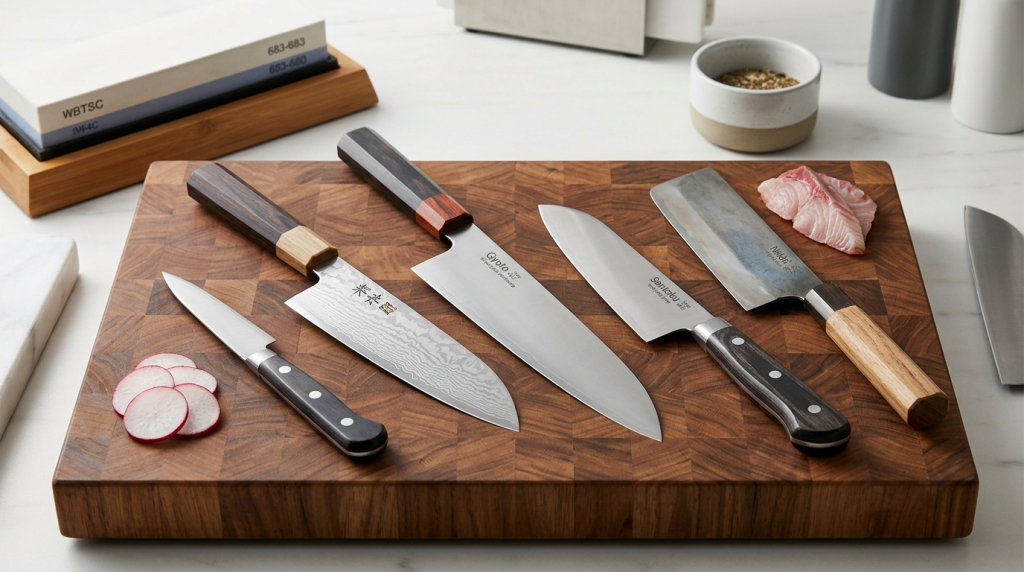
The Gyuto is the Japanese answer to a chef’s knife: a curved, multipurpose blade typically 210mm to 270mm long that handles proteins, vegetables, and fine knife work with confidence. It’s the most logical entry point for anyone new to Japanese knives versatile, familiar in feel, and immediately useful across all kitchen tasks.
Santoku — The All-Purpose Knife for Everyday Prep
The Santoku’s name translates as ‘three virtues’ meat, fish, and vegetables. Shorter and flatter than the Gyuto (165mm–180mm), it suits a push-cut technique and is lighter in the hand. It’s a natural choice for home cooks who mostly do vegetable and protein prep and don’t need the Gyuto’s extra length.
Nakiri — Built for Vegetables
The Nakiri is a flat-bladed vegetable knife with a squared tip. Its straight edge makes full-board contact on every stroke, producing clean, even cuts through vegetables without the rocking motion that a curved blade requires. It is a dedicated vegetable knife not designed for proteins or fish — and works best when used within that scope.
Petty — Precision for Small Work
At 120mm to 180mm, the Petty handles peeling, trimming, and detail work that a full-size blade makes awkward. Think of it as a paring knife with more reach. It pairs naturally with a Gyuto or Santoku to round out a two-knife setup.
Sujihiki — For Slicing Large Cuts
The Sujihiki is a long, narrow slicing knife (240mm–300mm) designed for breaking down roasts, salmon sides, or large cuts with a single draw stroke. Its slim profile minimizes drag and tearing. It’s a specialist blade not essential for most home cooks, but indispensable once you regularly work with large cuts of meat or sashimi-grade fish.
Steel Types: What’s Inside the Blade
• Carbon steel (Shirogami, Aogami): Takes the sharpest edge and is straightforward to sharpen on a whetstone, but requires drying after each use to prevent oxidation. Develops a patina over time.
• Stainless steel (VG-10, SLD, Ginsan): Slower to rust and more forgiving in humid kitchens. Slightly harder to sharpen but holds a reliable working edge for daily use.
• Clad steel: A hard core wrapped in softer stainless layers a practical middle ground combining a sharp cutting edge with rust-resistant cladding.
One clarification worth making: Damascus patterns are a visual finish created by folding or acid-etching cladding layers. They’re not a steel type. Always look at the underlying specification Aogami #2, VG-10, or similar to understand how a blade actually performs.
How to Choose the Right Knife
Start with three questions: What do you cut most? How much maintenance are you prepared to do? And what handle profile feels right in your hand? Proteins and mixed prep point toward a Gyuto. Mostly vegetables suggest a Nakiri or Santoku. Detailed work calls for a Petty. Carbon steel rewards discipline; stainless forgives inconsistency.
A curated selection of Japanese kitchen knives organized by format, steel type, and handle style makes it far easier to match the right blade to your cooking habits without being overwhelmed by a catalogue of hundreds.
What to Expect at Different Price Points
• Under $100 CAD: Reliable stainless production knives with solid geometry. A capable everyday blade.
• $100–$300 CAD: Better steel, more refined grinds, often small-batch production. The sweet spot for most serious home cooks.
• $300 and above: Hand-forged artisan blades where edge retention and cutting feel are genuinely different. Each knife carries its own character.
If your budget allows for mid-range from the start, that’s where to begin. A single well-chosen blade in good steel outperforms cycling through cheaper replacements.
Caring for Your Japanese Knife
Japanese knives are precision instruments and need to be treated as such. Three rules matter most: hand wash only (dishwashers destroy both the edge and the handle), use wood or soft-plastic cutting boards (never glass or ceramic), and sharpen on a whetstone typically 1000-grit to rebuild the edge, followed by 3000- or 6000-grit to refine it.
If whetstone sharpening is new territory, a specialist knife-sharpening and maintenance service that uses water stones is a sound alternative. Having the edge restored correctly is always better than attempting it incorrectly and removing more steel than necessary.
The Right Blade Changes How You Cook
Choosing the best Japanese knife in 2026 means matching blade geometry, steel type, and handle to the way you actually cook. A Gyuto in Aogami steel, chosen thoughtfully, will outperform a much more expensive blade that doesn’t suit your grip or prep style. Start with one well-chosen knife, learn to maintain its edge, and the difference will be obvious within the first week.
Japanese kitchen knives reward the attention you give them the more you understand the steel, the more every blade in your collection returns.
Which Japanese knife format made the biggest difference in your kitchen and what do you wish you’d known before buying your first one?
