

You are renovating a bedroom, finishing a basement, or replacing an old heater that is no longer heating as well as before. The question almost always arises at the same moment: baseboard heater or convector? Both appliances connect to the same 240 V circuit, consume the same amount of energy for equivalent power, and are found everywhere in Quebec. However, they don’t function in the same way, and the wrong choice can negatively affect the comfort of an entire room. This article explains the key differences to help you make the right decision.
Two Technologies, Two Ways to Heat
The Baseboard Heater: Heat by Natural Convection
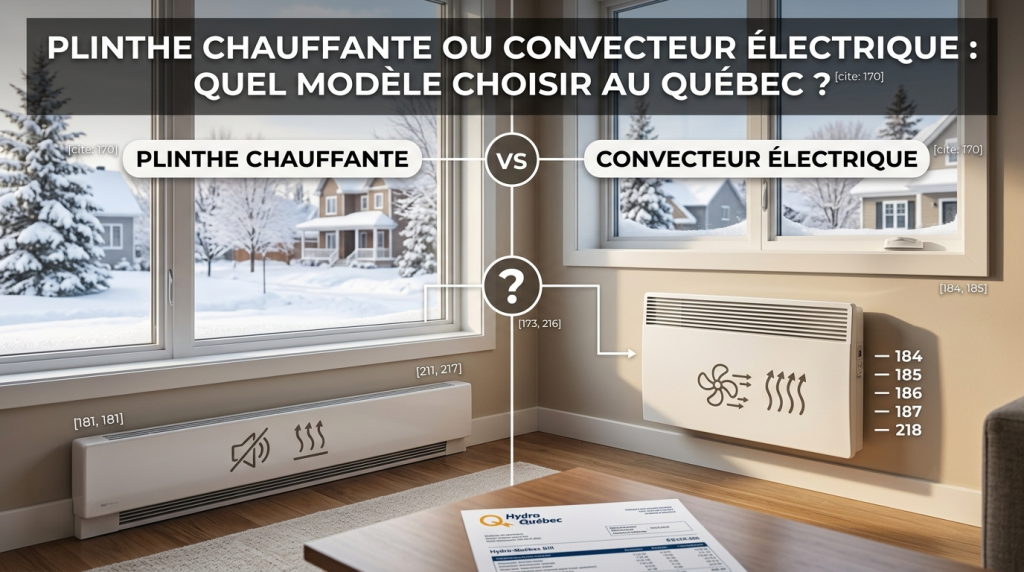
The baseboard heater heats the air in direct contact with its resistance element. The hot air rises along the wall through natural convection, without a fan, without noise. This is its great strength: totally silent operation, ideal for a bedroom or reading room. It heats more slowly than the electric convector because it depends on natural air circulation. However, in a well-insulated room with few drafts, the temperature rise remains very satisfactory.
The Wall Convector: Forced Air Circulation
The electric convector (also called a wall convector) includes a fan that accelerates the circulation of hot air in the room. Result: heat is distributed more quickly and uniformly, from floor to ceiling. This speed makes it an excellent choice for rooms with high heat loss (entrances, poorly insulated rooms, semi-open spaces) or for spaces where you want to feel the warmth as soon as you enter. The drawback: a slight ventilation noise that some people perceive in complete silence.
Choose Based on Your Room and Lifestyle
Bedroom, Office, Living Room: The Baseboard Reigns
In spaces where you spend time resting or concentrating, the baseboard heater is essential. Its total silence is incomparable. It is easily installed along exterior walls, under windows, to counteract the cold drafts descending from the panes in the Quebec winter. It is also suitable for rooms where heating is continuous at a stable temperature, controlled by a programmable thermostat. When combined with a precise electronic thermostat, it offers excellent control over energy consumption.
Entrance, Hallway, Bathroom: The Convector Takes the Advantage
For a vestibule you cross quickly, a bathroom where you want immediate warmth after a shower, or a hallway you only occupy for a few minutes, the electric convector is a better fit. Its ability to quickly raise the temperature avoids keeping the heat active all day. In basements with cold foundation walls, electric heating in the form of a wall convector can also be more effective in compensating for significant thermal losses. To explore available models, the residential electric heating collection from E3 Électricité includes baseboard heaters and convectors adapted to Quebec’s climatic realities.
Energy Consumption: The Thermostat Makes All the Difference
A persistent misconception exists: that the convector consumes less electricity than a baseboard heater. In reality, at equal power, both appliances convert exactly the same amount of electricity into heat. The difference lies in the duration of operation. A convector that heats faster can turn off sooner, which reduces the cycle time. Conversely, a baseboard heater that maintains a stable temperature in a well-insulated room can operate on very short cycles. It is the electronic thermostat (preferably programmable) that truly optimizes your Hydro-Québec bill, regardless of the technology chosen.
For the baseboard heater thermostat, ensure that its ampacity corresponds well to the total power of the appliances connected to the same circuit. An undersized thermostat overheats, prematurely ages, and can become a source of electrical problems.
Installation: A Step That Cannot Be Improvised
In Quebec, any fixed electric heating appliance must be installed by a holder of an RBQ license. This requirement of the Quebec Construction Code is not a mere formality: it guarantees that the wiring, circuit protection, and appliance mounting comply with the safety standards in effect. A poorly installed appliance (inadequate conductor gauge, unsuitable circuit breaker, or approximate connection) represents a real fire hazard, especially in an old dwelling. This applies as much to a simple auxiliary baseboard heater as it does to a more powerful convector.
The installation of baseboard heaters and convectors by an RBQ license holder not only ensures installation conformity but also protects your home insurance coverage. Many companies refuse claims related to an electrical fire caused by non-compliant work.
In Summary: Which Option is Right for You?
The baseboard heater or the convector: neither is universally superior. The baseboard heater wins for silence and thermal stability in rooms with prolonged use. The wall convector is essential where heating speed and uniform distribution are paramount. In many Quebec homes, both coexist: baseboard heaters in the bedrooms and living room, and electric convectors in rooms used occasionally. The key is to choose the right power for each room, combine it with a quality thermostat, and have the installation carried out according to the highest standards.
And you: have you ever replaced baseboard heaters with convectors in your home, or vice versa? What motivated your choice? Share your experience in the comments.
