

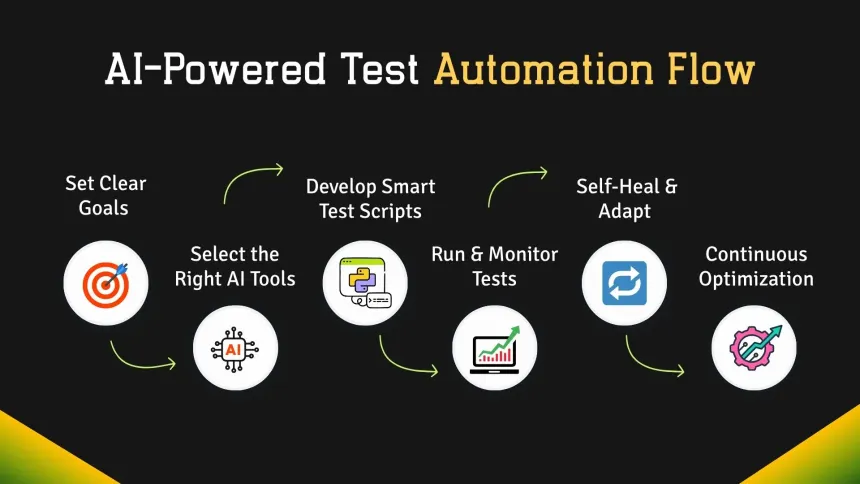
The importance of software testing increases in tandem with development efficiency. Rapid release cycles, the rise in third-party dependencies, and an increased reliance on APIs have created significant hurdles for software testing. In many cases, software is being released without the necessary security checks. This challenge is particularly evident in environments using a low-code development platform, where accelerated development can outpace traditional testing processes. It is at this point that the impact of artificial intelligence tools on software development is becoming increasingly apparent.
Incorporating artificial intelligence software testing faster release cycle. In today’s world, it has become a necessity to test AI applications rather than an option. The demand for AI testing assistants is rising, and this trend is anticipated to continue in the coming years. AI and the underlying machine learning enable the automation of testing processes, including the creation, execution, and analysis of tests. These technologies promote market expansion by providing end users with logical features.
In this article, we will comprehend the autonomous AI-powered testing assistant and its contributions to faster cycles. We will also explore the top AI-powered testing assistants and key tasks that they perform in software testing.
AI-Powered Testing Assistant
AI-powered testing assistants are an effective way to increase the efficiency of testing tasks. They enable testers to optimize and automate the Software Development Life Cycle stages. This assists QA teams in maintaining excellent software quality and exhibiting remarkable workflow efficiency.
Natural language processing, machine learning, and other artificial intelligence-based technologies are all combined in AI-based tools. The revolutionary AI-based software testing is equivalent to having a continually vigilant assistant that assesses software, finds potential flaws, and generates test cases. This technology not only simplifies software testing but also enhances the testing cycle itself.
Contributions of AI-Powered Testing Assistant in Faster Cycle
- Scalability- More scripts mean more testing. As it requires a lot of human effort to handle such large volumes of data, traditional testing methods lag in this situation. An AI-powered testing assistant is excellent for large-scale testing, enabling developers to perform their tasks more efficiently. It also offers comprehensive coverage and accurate error detection. This scalability enables testing across a variety of platforms, devices, and scenarios, even in large code bases.
- Continuous Improvement- The AI testing assistant is built with genetic algorithms and can be configured to gain knowledge and grow over time. Because these tools learn about the applications being tested while it is running, they improve the test based on how the application behaves during runtime. This enables such systems to improve with each test run, resulting in findings that are beyond the capabilities of most traditional testing tools.
- Reducing Maintenance and Flaky Tests- Test script maintenance is a common issue in test automation. Testers have to put in a significant amount of effort to debug problems and determine what went wrong. AI’s self-healing mechanism can help avoid such situations. It begins by identifying errors in tests before they arise, and hence corrects them before they feel the possibility of failure. Autonomous AI aids in eliminating flaky tests, which fail randomly during execution.
- Surpassing Manual Testing Limitations- While a standard unit test only evaluates one scenario at a time, Autonomous AI tools can extend it to test the same function or API with a huge number of unexpected or incorrect data. This enables developers to automatically detect problems and vulnerabilities in places they would never have considered to test.
- Increased Test Coverage- Self-learning algorithms continually improve test coverage with each new data input. Traditional dynamic testing techniques interpret the application under test as a black box, but the white-box approach provides developers with complete access to the software’s internal workings. Furthermore, having access to the source code facilitates debugging since results can be quickly traced back to the relevant aspects of the source code.
- Self-heals broken test scripts- Self-healing is one of the most notable features for AI adoption in software testing. Changes to the UI or code frequently occur in software testing. AI tackles this prevalent issue by allowing auto-adaptation to changes in the application’s user interface or code. The AI integration updates the necessary test cases and eliminates test failures caused by small UI changes. This significantly minimizes test maintenance and the requirement for manual intervention to fix faulty scripts.
Important Tasks That an AI Testing Assistant Serves
- Mark Flaky Test Assistant– Identifies and marks flaky tests in the project, making them easier to identify. Flaky test detection is also available on the Analytica dashboard. Testers may regulate the computation of flaky tests by establishing the minimum and maximum success rate in analytics configuration to define what qualifies as flaky.
- Mark Failed Test Assistant- Automatically flags and labels failed tests from recent runs, allowing QA teams to swiftly detect, prioritize, and manage issues in large or complicated test suites.
- Run Statistics Analysis- A broad summary of the complete test run allows stakeholders to get familiar with test findings at a glance.
- Write Descriptions from Code- Generate descriptions automatically for automated tests by writing descriptions from code. To enhance readability and documentation across the project, the AI assistant analyzes the code of each test and generates insightful descriptions. This lets teams rapidly grasp test coverage without delving into the details of implementation.
- Deep Analyze Agent- It is developed to provide testers with a thorough picture of the testing performance of the project. The assistant automatically compiles reports from several runs rather than having testers do it manually. It gives stability insights and release readiness, scans tests, and thoroughly evaluates test coverage and running statuses. Additionally, the data collection duration can be configured in the testing infrastructure.
- Transform the Project to BDD- BDD adoption is made easy and effective by an AI assistant that uses Gherkin syntax to convert conventional tests into BDD format without the need for manual rewriting. The approach is quite simple: the title turns into “Scenario,” the prerequisites become “Given,” and the expected results become “Then steps.”
Top Autonomous AI-Powered Testing Assistant
- KaneAI by LambdaTest
LambdaTest’s KaneAI is a generative AI tool that speeds up the testing cycle by implementing AI for software testing and streamlining crucial processes across the software development lifecycle. Developers and QA teams can create higher-quality software more quickly owing to its reduction of manual labor, acceleration of execution, and provision of insightful data. KaneAI uses Large language models (LLMs) to automatically create and modify complex test scripts from requirements, user stories, or plain English instructions.
LambdaTest is an AI testing tool to run manual and automated tests at scale. The platform allows testers to perform both real-time and automation testing across more than 3000+ environments and real mobile devices. Through the automation and optimization of multiple tasks throughout the development process, LambdaTest’s AI assistants speed up the software testing cycle. From creating test cases and fixing scripts to evaluating data and anticipating errors, it does everything.
Key Features
- Cloud-based, scalable solution for automated and manual testing.
- Continuous testing using AI-powered metrics, collecting and analyzing.
- Reduces the regression test cycle by prioritizing the execution of high-risk test cases and predicting which tests are most likely to fail based on historical data and code changes.
- Through log analysis and data tracing, the AI assistant automatically completes RCA on failed tests.
- Helps testers find and address problems more quickly by identifying the most likely causes of failure.
- Its Self-healing mechanism automatically modifies test scripts in response to changes in operations or user interface elements. This reduces maintenance work and keeps tests from failing due to small application modifications.
Parasoft
Quality at the user interface layer is a top priority for Parasoft, which uses AI to remove false positives and provide a flawless user experience. Additionally, it has visual testing features that save human effort and provide a definite return on investment. There is no need for additional tests because the AI testing assistant can be easily integrated into existing test environments. For complete coverage, they can be run alongside functional tests.
Key Features
- Speeds up testing cycle automation and lowers time-to-market.
- Easy-to-use Test Editor for effective test management, validation, and creation.
- Digital twin testing methodology based on models for thorough coverage.
ACCELQ
ACCELQ is a robust, low-code artificial intelligence test automation system that requires considerably less work and provides dependable end-to-end test coverage. Teams can move performance testing earlier in the development lifecycle because of the platform’s seamless integration of load testing. ACCELQ speeds up application development by reducing infrastructure and operating expenses.
Key Features
- A comprehensive, low-code test automation solution that provides load testing.
- Performance testing can be performed earlier in the development process.
- Makes it possible for software teams working at fast speeds to design, carry out, and maintain reliable tests.
- An open-source tool for testing web applications.
- Simulates user behavior in various browsers.
- Develops tests that are easy to understand and maintain.
Tricentis
Tricentis offers a continuous quality platform that makes it simple to manage the testing environment. It provides automated end-to-end testing to develop high-quality software quickly and at scale. Tricentis’s solutions cover every stage of the development process, from coding to user interface. To ensure high-quality deliverables, the platform checks test results, validates application dependability, and expands code and test coverage.
Key Features
- Intelligent low-code tests that prepare the team’s skills for the future.
- Increased automation through integration with an unrestricted DevOps cycle.
- Automated and codeless testing that empowers non-technical users.
- Using AI/ML to minimize test maintenance.
- A cloud-based technology that facilitates isolated collaboration.
- Allows for thorough testing across many devices and browsers.
Watir
Watir provides testers the ability to achieve the efficiency of top-tier automation by offering low-code automated testing services. Using AI-powered tools for application development, testers can create and build test suites with little to no programming experience. These test suites can be fully automated. This expedites release cycles and enhances user experience. Additionally, it creates a collaborative environment with automation experts who can concentrate on more code-specific parts of software development, resulting in democratized testing.
Key Features
- Compatibility with a wide range of platforms and devices, and software categories.
- Improves quality assurance procedures with its user-friendly, safe, and quick interface.
- Visual testing for UI and UX is driven by AI, which lowers false positives.
- AI Visual Testing’s smooth incorporation into existing tests.
- Can execute both functional and visual tests.
- Intelligent comparisons to find important modifications to the content and design of the application.
Conclusion
In conclusion, Software testing has been greatly enhanced by the AI-Powered Testing Assistant. AI in test automation increases the effectiveness, accuracy, and flexibility of the testing cycle to the next level. It expedites the application’s quality assessment procedure while also increasing accuracy and consistency.
AI-powered assistants enable testers to expand test coverage, identify issues faster, and expedite test cycles without wasting resources or test suites. By using an intelligent assistant to test selection and execution, organizations can attain the optimum balance between speed and quality. AI methods combined with conventional testing can speed up development and find even the smallest problems. This increases the effectiveness of software development.
