

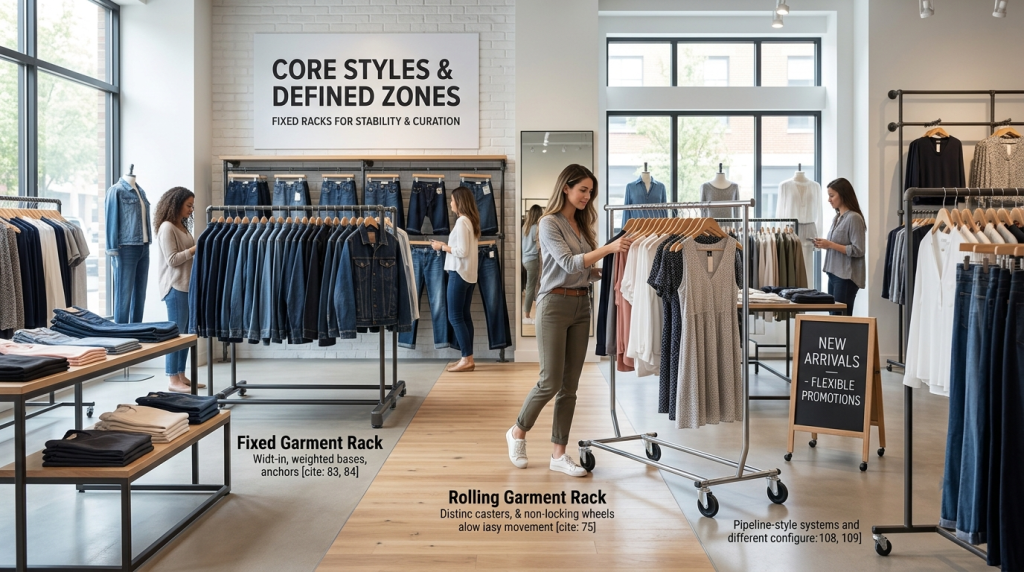
Walk the floor of any clothing store and the fixture choice is immediate: racks that stay put, or racks that move. It sounds like a minor operational detail, but the decision shapes how your staff resets displays, how customers navigate your floor, and whether your garment presentation holds up under the pressure of a busy Saturday. This comparison breaks down rolling racks and fixed garment racks across the criteria that matter most to working retailers.
What Makes a Rolling Rack Different
A rolling garment rack is built for movement. Four casters — typically a combination of locking and non-locking wheels — allow the unit to be repositioned without disassembly. The hangrail sits above the base, and the entire structure can be rolled between the sales floor, a fitting room area, or a stockroom in seconds.
That mobility is the defining characteristic. A rolling rack for clothes does not commit to a location. It adapts as your floor plan changes, whether that means staging inventory before a reset or clearing floor space for a trunk show. For any clothing rack for retail store use where resets happen frequently, that flexibility reduces labor time on every cycle.
Rolling racks are available in several configurations: Z-racks with their distinctive angular base, S-racks that nest compactly side by side, and double-rail models that increase hanging capacity within the same footprint. Each suits a different volume and garment type.
The Case for Fixed Garment Racks
Fixed garment racks prioritize stability and visual permanence. Anchored to the floor or wall, or simply engineered with a wide, weighted base, these units do not move during the shopping day. That stability carries a distinct merchandising advantage: garments hang consistently, presentation stays aligned, and the overall fixture reads as part of a deliberate store design rather than a temporary arrangement.
Retailers in fashion boutiques, specialty apparel, and higher-end environments often prefer fixed racks precisely because permanence signals intent. When a fixture does not shift between visits, repeat customers build spatial memory around it. They know where the new arrivals live, where the denim sits, where the outerwear begins. That spatial reliability reduces browsing friction and improves sell-through on core categories.
Fixed configurations also tend to support heavier loads. Without casters, the weight transfers directly to the floor, which means thick denim, leather jackets, and winter outerwear can fill a fixed rack without the wobble risk that lighter rolling models carry under maximum load.
How to Decide: Key Operational Questions
How often does your floor plan change?
If you rotate promotional sections weekly, run seasonal rollouts across multiple zones, or rely on flexible staging during shipment processing, rolling racks earn their place. If your floor plan is stable and only changes quarterly or seasonally, fixed racks offer cleaner execution and require less staff coordination to maintain.
What are you hanging?
Lightweight to mid-weight apparel — tops, shirts, light dresses — works well on most rolling configurations. Heavy outerwear, dense denim walls, or leather goods benefit from the load distribution that fixed or heavy-duty commercial garment rack designs provide. Review the weight capacity specifications before committing to a rolling unit for demanding categories.
What is your stockroom situation?
Rolling racks serve double duty. Retailers who use them on the sales floor during the day can wheel the same units into a stockroom for staging overnight or between deliveries. Fixed racks do not travel. If your back-of-house is tight and your sales floor needs to flex, rolling configurations reduce the total number of fixtures you need to own.
What does your store environment communicate?
Brand environment matters. A fast-fashion retailer running high-volume weekly resets has different visual priorities than a boutique positioning garments as considered purchases. Fixed racks align with permanence and curation. Rolling racks align with energy, newness, and change. Neither is wrong — but the choice should reflect your brand’s visual strategy, not just your operational defaults.
Where the Two Types Work Together
Many retail floors use both. A common approach is to anchor core categories — denim, basics, signature collections — on fixed racks positioned along walls or in defined floor zones, while using rolling configurations for promotional merchandise, new arrivals, and seasonal transitions in higher-traffic areas.
This hybrid approach lets you maintain the stability of a permanent floor plan while retaining the speed needed to respond to inventory changes, promotions, and seasonal resets. Sourcing a consistent retail clothing display rack that spans both fixed and rolling formats from a single supplier also simplifies reordering and ensures your fixtures match in finish and tubing profile across the sales floor.
Pipeline-style garment systems take this further by offering racks that can be configured as either stationary or mobile depending on the caster setup. Retailers running multi-location environments often standardize on this type of system specifically because the same fixture design can serve both purposes without introducing visual inconsistency between stores.
A Practical Summary
- Rolling racks suit high-frequency resets, lean teams, stockroom-to-floor workflows, and flexible floor plans.
- Fixed garment racks suit stable brand environments, heavy merchandise categories, and stores where visual permanence supports the customer experience.
- Most retail floors benefit from both types used in defined roles, not as substitutes for each other.
- Specify weight capacity, tubing dimensions, and finish before purchasing either type to ensure compatibility with your add-ons and existing fixtures.
The fixture choice is not about which type is better in the abstract. It is about which type serves the specific zone, category, and reset rhythm of your operation. Get the brief right and the rack selection follows.
Which configuration does your store rely on most, and has that changed as your floor plan evolved? Drop your answer in the comments below.