

In this guide, you’ll learn:
- What is multilayer plastic (MLP), with real-world examples?
- Why brands use it—and why recyclers struggle with it
- What do Indian rules say about multilayer packaging and producer responsibility?
- Practical fixes: design changes, collection models, and recycling pathways that are realistic today
Introduction: The packaging that protects… and complicates everything
Open a chips packet, a coffee refill pouch, a shampoo sachet, or a toothpaste tube and you’ll likely touch multilayer plastic. It’s the “quiet workhorse” of modern packaging because it combines strength, flexibility, printability, and strong barrier protection—often in a single thin film. The same structure that keeps oxygen, moisture, and light out (so products stay fresh longer) also makes MLP one of the toughest materials to sort and recycle in real waste systems.
If you’ve ever wondered why some packaging feels metallic, crinkly, and unusually “sturdy” for its thickness—MLP is a top reason.
What is multilayer plastic (MLP)?
In India’s Plastic Waste Management (PWM) Rules, “multi-layered packaging” is defined as packaging that has at least one plastic layer combined with one or more layers of materials like paper, paperboard, polymeric materials, metallised layers, or aluminium foil, either as a laminate or a co-extruded structure.
Banyan Nation describes multilayer plastic as engineered packaging in which different layers can play different roles—moisture barrier, oxygen barrier, structural strength, or improved printability—and notes that some packs can have up to ~12 layers in complex structures.
Common MLP examples you see daily
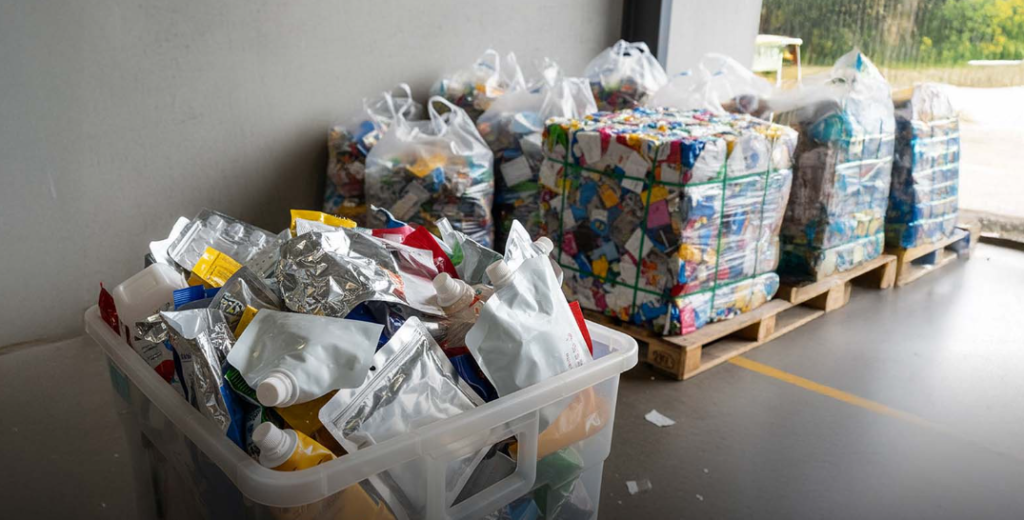
- Snack packets (chips, biscuits), coffee refills, instant food pouches
- Sachets (shampoo, conditioner, ketchup, mouth freshener)
- Tubes (toothpaste, creams) and some dairy or condiment packs
- Cartons that combine paper + plastic + aluminium (often treated separately because they need pulping first)
Why brands use multilayer packaging
MLP exists because single materials often fail at one key job: barrier, shelf life, cost, and convenience.
Research on multilayer packaging highlights that these structures help deliver barrier properties against oxygen, water vapour, light, and flavour loss, thereby supporting long shelf life and reducing food losses in supply chains.
In plain terms: MLP helps products survive heat, humidity, transport, handling, and long storage without going stale, leaking, or degrading. That’s why FMCG and packaged food rely heavily on it.
The core problem: MLP is designed for performance, not for recycling
Most recycling systems work best when a package is one main polymer (like PE, PP, or PET), easy to identify, and easy to melt into a predictable output. MLP flips that logic: multiple materials are bonded to act as one.
Banyan Nation summarizes the key technical barriers clearly:
- Material incompatibility: layers may include PE, PP, PET, EVOH, polyamide (nylon), plus sometimes aluminium—these behave differently during melting.
- Adhesive/tie layers: many laminates use strong adhesives that don’t separate by normal mechanical processing.
- Contamination: thin films often carry oils, sauces, or residues that reduce recyclate quality.
- Sorting blind spots: common NIR (near-infrared) systems often read surface signals and can miss multilayer structures, especially thin/opaque/printed films.
That’s why multilayer packaging is frequently treated as “non-recyclable” in practice and ends up in thermal recovery or disposal routes when no dedicated solution exists.
What Indian rules say (and why it matters)
India’s PWM Rules place responsibility on producers and brand owners—not only on municipalities or consumers.
Key points that directly relate to multilayer packaging:
- Primary responsibility for collection of used multilayer plastic sachets/pouches/packaging lies with Producers, Importers, and Brand Owners (PIBOs), who must establish a collection system and submit plans to SPCBs/PCCs.
- The rules state that multi-layered plastic that is non-recyclable / non-energy recoverable / with no alternate use should be phased out within two years (wording updated via amendment).
- Marking/labelling requirements apply to multilayer packaging (manufacturer name/registration number, etc.).
This regulatory push is important because MLP economics are tough: it’s lightweight, low-value per unit, and expensive to collect cleanly at scale. A serious EPR system changes the incentives.
Why “just burn it” isn’t a clean fix
When multilayer packaging can’t be recycled mechanically, it often gets routed to incineration or waste-to-energy proposals. But environmental groups argue this route has significant downsides: incineration can create toxic pollutants and leaves ash that still requires safe handling and disposal.
Even when “energy recovery” is allowed as an option, it shouldn’t become the default excuse to keep producing packaging that cannot be realistically recycled.
What actually helps: a practical roadmap
There’s no single silver bullet—credible research suggests a mix of strategies is likely, depending on regulation, technology access, and collection quality.
1) Design changes that reduce multi-material complexity (the fastest lever)
If you control packaging design, your biggest win is reducing layers and incompatible materials.
A major circular economy recommendation for flexibles is to shift multi-material flexibles to mono-material designs wherever possible, and reduce non-polymer content (like heavy coatings/inks/glues) to improve recyclability. Practical design moves brands can adopt:
- Replace PET/Al/PE style laminates where possible with recyclable mono-material PE/PP structures (depending on product needs)
- Avoid metallised layers unless absolutely necessary
- Use inks/adhesives that are compatible with recycling streams (or minimize them)
2) Build collection models that match MLP reality
MLP fails in “hope recycling.” If you want recovery, collection must be intentional:
- Take-back programs (through retail networks or distributors)
- Aggregation via MRF partnerships
- EPR-funded collection incentives so low-value films are still worth picking up
3) Recycling pathways: mechanical, compatibilization, delamination, and chemical routes
A well-known review of multilayer recycling options groups solutions into:
- Separation approaches (delamination, selective dissolution–reprecipitation)
- Processing together using compatibilization to blend immiscible polymers
- Chemical/feedstock recycling, which is attracting investment but raises questions on cost and real environmental benefit depending on process and energy source
The key is honesty: today, many multilayer structures still lack a mainstream, scalable recycling route across regions, so prevention and redesign remain essential.
How to identify multilayer plastic quickly (consumer-level)
You don’t need lab equipment—use simple cues:
- Feels crinkly, stiff, and “high barrier” (like chips packets or coffee pouches)
- Often shiny/metallised inside
- Holds shape more than a basic carry bag. Banyan Nation notes MLP can be hard to identify visually, but strong barrier performance and that distinct “packaging film feel” are useful signals.
Bottom line: treat MLP as feedstock, but redesign the future
Multilayer plastic exists because it delivers real packaging performance. But without redesign and serious investment in collection and processing, it will keep leaking into landfills and the environment.
The most realistic path is:
- Reduce multi-material packaging where you can
- Redesign what must remain into recyclable-by-design structures
- Recover the unavoidable remainder through EPR-funded collection and the best available recycling route
That’s how MLP shifts from “unrecyclable waste” to managed feedstock—without pretending the challenge is already solved.
