

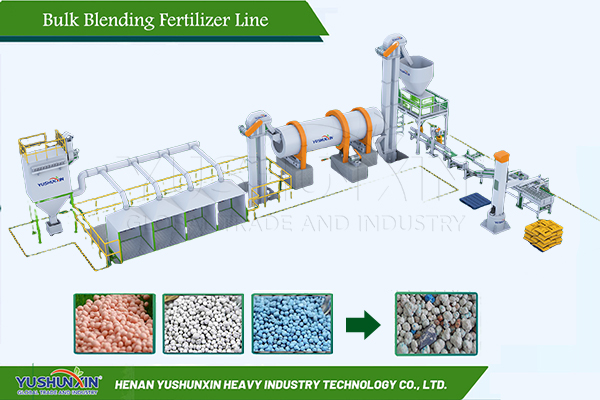
As fertilizer producers adapt to changing agricultural demands, the comparison between BB and NPK fertilizer production has become a frequent topic of discussion. Both products serve important roles in modern farming, yet their production methods, investment requirements, and final output differ significantly. Understanding these differences is essential for investors and manufacturers deciding which technology best suits their market goals. At the center of this discussion is the BB Fertilizer Production Line, a system valued for its efficiency, flexibility, and cost control.
Understanding BB Fertilizer Production
BB fertilizer, also known as bulk blended fertilizer, is produced by physically blending pre-granulated raw materials such as nitrogen, phosphorus, and potassium in specific ratios. The BB Fertilizer Production Line is designed to focus on accuracy and uniform mixing rather than chemical transformation. This allows producers to quickly adjust formulas based on soil conditions, crop requirements, or regional demand.
A major advantage of the BB Fertilizer Production Line is its operational simplicity. Since raw materials are already granulated, the production process avoids complex reactions and high-temperature processing. Cementl has optimized this approach by designing BB Fertilizer Production Line systems that emphasize stable material flow and precise proportioning, ensuring consistent product quality with lower operational risk.
How NPK Fertilizer Production Works
NPK fertilizer production is a more complex industrial process. It typically involves chemical reactions, granulation, drying, cooling, and screening. Raw materials must be processed into compound granules, which requires higher energy input, stricter process control, and more advanced environmental management systems.
While NPK fertilizers offer uniform nutrient distribution within each granule, the production process is capital-intensive. Compared to a BB Fertilizer Production Line, an NPK plant demands greater investment, longer commissioning time, and higher operating costs. This makes NPK production more suitable for large-scale manufacturers with stable, high-volume demand.
Process Complexity and Production Flexibility
One of the most noticeable differences between the two systems lies in flexibility. A BB Fertilizer Production Line allows rapid formula changes without major equipment adjustments. This flexibility is especially valuable in regions with diverse soil profiles or seasonal crop variations.
NPK production lines, by contrast, are less adaptable. Changing formulas often requires recalibration of chemical ratios and process conditions, which can lead to downtime. Cementl’s BB Fertilizer Production Line solutions are designed specifically to support fast market response, making them attractive for producers who prioritize customization and speed.
Output Quality and Market Application
Both BB and NPK fertilizers deliver nutrients effectively, but their output characteristics differ. Products from a BB Fertilizer Production Line consist of blended granules, each carrying a single nutrient. This makes application precision dependent on proper blending and spreading techniques.
NPK fertilizers contain all nutrients within each granule, offering uniform nutrient distribution per particle. However, this advantage comes at the cost of higher production complexity. Cementl ensures that BB Fertilizer Production Line output meets market expectations by focusing on blend uniformity and granule compatibility, reducing segregation during transport and application.
Investment Cost and Operating Economics
From an investment perspective, a BB Fertilizer Production Line requires significantly lower capital than an NPK plant. Equipment costs, installation time, and infrastructure requirements are all more manageable. Operating costs are also lower due to reduced energy consumption and simpler maintenance.
NPK plants, while capable of large-scale production, involve higher financial risk. Cementl helps mitigate this risk for BB fertilizer producers by offering modular BB Fertilizer Production Line designs that allow gradual capacity expansion without major reinvestment.
Environmental and Operational Considerations
Environmental compliance is increasingly important in fertilizer production. A BB Fertilizer Production Line has a smaller environmental footprint because it avoids chemical reactions and intensive drying processes. Dust control and material handling remain important, but overall emissions and waste are easier to manage.
Cementl incorporates environmentally conscious design principles into every BB Fertilizer Production Line, helping producers meet regulatory requirements while maintaining efficient operations. NPK plants, on the other hand, require more advanced emission control systems and stricter monitoring.
Conclusion: Choosing the Right Production Path
The choice between BB and NPK fertilizer production depends on market strategy, investment capacity, and operational priorities. A BB Fertilizer Production Line offers flexibility, lower cost, faster setup, and easier customization, making it ideal for regional producers and evolving markets. NPK production suits large-scale manufacturers focused on standardized, high-volume output.
With experienced engineering support from Cementl, a BB Fertilizer Production Line becomes a strategic tool for producers seeking efficiency, adaptability, and long-term profitability. Understanding these key differences allows businesses to invest with confidence and align production technology with real market needs.
