

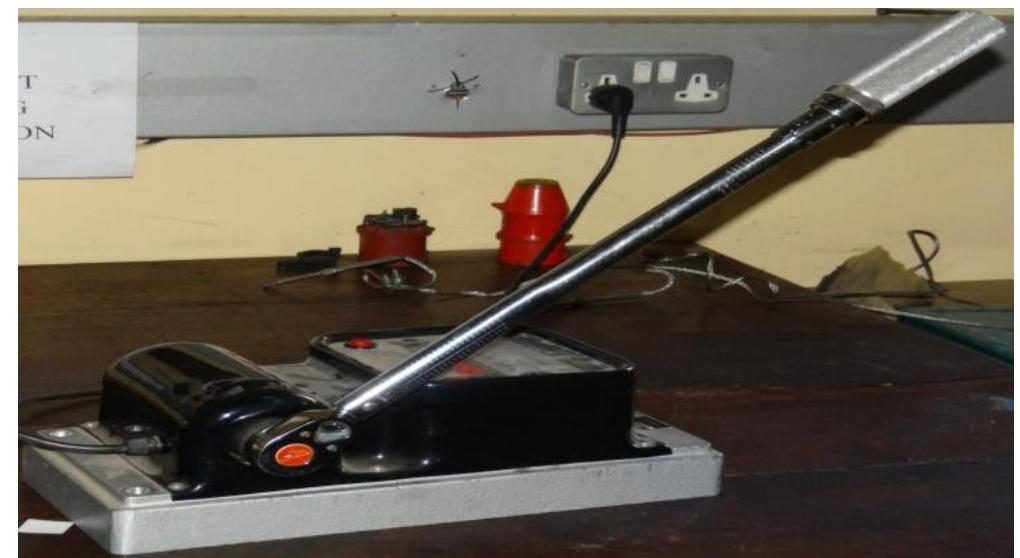
Torque wrenches are precision instruments, yet many organizations underestimate the complexity involved in validating their accuracy. While basic calibration verifies torque output at a few key points, advanced torque wrench calibration examines deeper aspects—such as mechanical hysteresis, resolution limits, uncertainty contributions, and dynamic loading behavior—that significantly impact torque accuracy in real-world applications.
SIMCO provides advanced torque calibration services designed to uncover subtle performance issues that are often missed in basic checks. These deeper evaluations are essential in aerospace, medical device manufacturing, military assemblies, robotics, automotive systems, and other industries where torque performance is mission-critical.
Going Beyond Basic Torque Verification
Traditional torque calibration assesses whether a torque wrench produces the correct torque within an allowable tolerance. However, high-risk industries often require more comprehensive insight into wrench behavior.
1. Hysteresis and Directional Sensitivity
Mechanical torque wrenches may produce different readings depending on whether torque increases gradually or is approached rapidly. This difference—known as hysteresis—is a major contributor to measurement error.
SIMCO’s advanced procedures examine:
- Clockwise vs. counterclockwise accuracy
- Steady-state vs. ramped loading
- First cycle vs. subsequent cycles
These factors directly affect torque repeatability in production environments.
2. Resolution and Indication Effects
Digital torque wrenches have finite resolution. When resolution is too coarse relative to required tolerances, small variations in torque application may go undetected.
Advanced calibration evaluates:
- Display resolution
- Internal sampling rates
- Peak vs. real-time measurement modes
Correct interpretation of results requires uncertainty analysis—and SIMCO provides documentation that aligns fully with ISO/IEC 17025 requirements.
3. Load Application Rate
Torque accuracy depends heavily on loading speed. Applying torque too quickly may cause overshoot; applying too slowly may lead to spring compression lag and inaccurate indication.
SIMCO uses controlled loading devices that maintain consistent torque application rates to ensure defensible calibration data.
Understanding Measurement Uncertainty in Torque Calibration
Torque calibration uncertainty is influenced by:
- Reference transducer calibration uncertainty
- Mechanical friction in fixtures
- Temperature effects on strain gages
- Repeatability of wrench release mechanisms
- Technician influence
- Gear or spring hysteresis
Regulated industries must know whether uncertainty is acceptable relative to product tolerances. For organizations requiring full traceability and defensible uncertainty budgets, SIMCO’s accredited torque tool calibration provides the necessary documentation.
Many companies pair torque calibration with SIMCO’s enterprise-wide calibration management programs, ensuring that torque tools and related equipment remain controlled across all facilities.
Dynamic Torque and Real-World Loading Conditions
Some torque wrenches behave differently under dynamic loads such as:
- Pulsing torque from pneumatic drivers
- Tool flex under high force
- Reaction arm influence on electronic wrenches
- Fastener seating behavior
Advanced torque calibration replicates or evaluates these conditions to ensure real-world performance aligns with engineering requirements.
Environmental Effects on Torque Output
Torque tools are sensitive to environmental factors such as:
- Temperature changes affecting spring elasticity
- Humidity influencing lubrication performance
- Contaminants increasing internal friction
SIMCO maintains controlled environmental conditions during calibration to minimize measurement variation and ensure consistency.
Best Practices for Torque Wrench Longevity
- Avoid sudden impact or drop events
- Store tools in temperature-stable environments
- Apply force smoothly during use
- Avoid exceeding the tool’s rated capacity
- Retract click wrenches to their lowest setting when stored
- Use usage-based calibration intervals for high-volume tools
Conclusion
Advanced torque wrench calibration goes beyond simple torque verification to evaluate uncertainty, mechanical behavior, environmental influence, and real-world performance characteristics. SIMCO’s deeper calibration approach ensures fastener integrity, reduces risk, and supports compliance in industries where precision torque application is essential.
