

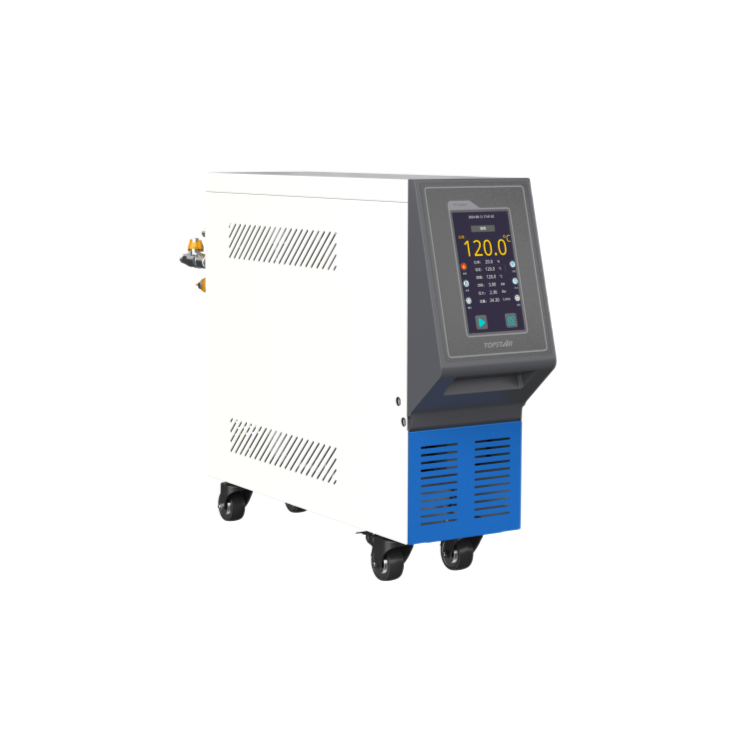
Every minute saved in cycle time increases production, reduces energy consumption, and improves overall equipment utilization. Mold preheating is one of the most time-consuming stages in the molding process. The mold must reach a stable temperature before production can begin. Slow or uneven preheating can lead to defects such as warping, sink marks, or missing parts.
According to industry studies, inefficient temperature control can increase preheating time by up to 30%, wasting both energy and labor. Therefore, mold temperature controllers with PID control are a key solution. By continuously monitoring and adjusting heat input, PID control enables the mold to reach the target temperature faster and maintain it more accurately.
Understanding the Functionality of a mold temperature controller with PID control
To reduce preheating time, it is important first to understand how a mold temperature controller with PID control works. A mold temperature controller is a thermal regulation device that circulates a heat transfer fluid through the mold to maintain a constant temperature during the molding process.
Traditional controllers typically use simple on/off control, reacting only when the temperature deviates from a set threshold. However, this approach can cause temperature fluctuations and delays during the preheating phase. In contrast, a mold temperature controller with PID control continuously calculates temperature errors and dynamically adjusts heating output.
The proportional component responds to the difference between the current setpoint and the actual temperature. The integral component corrects accumulated overload errors, while the derivative component predicts future trends to stabilize the temperature response. This coordinated control minimizes overshoot and ensures the mold reaches the desired temperature more quickly.
How does PID control reduce warm-up time for mold temperature controllers?
The core benefit of using a mold temperature controller with PID control is its ability to deliver heat accurately and efficiently during the warm-up phase. Without PID control, temperature overshoot is typical; the mold may exceed the desired temperature and require cooling to stabilize, resulting in wasted time. PID control eliminates this inefficiency through predictive adjustments.
Another key benefit is energy optimization. Because the system continuously calculates heating needs, unnecessary power consumption during the warm-up process is avoided. Over time, this can reduce overall energy consumption by 10% to 15%, further improving operational efficiency. Ultimately, mold temperature controllers with PID control shorten preheating times by maintaining consistent heat input, preventing temperature oscillations, and stabilizing mold temperature more quickly, which allows for faster production starts and reduces downtime between mold changes.
Optimizing PID Parameters for Faster Mold Preheating
Effective use of mold temperature controllers with PID control requires proper parameter tuning. The controller’s responsiveness depends on how its proportional, integral, and derivative settings are configured. Improper tuning can result in oscillation, slow heating, or unstable temperature control.
Proportional Gain (P): Determines how strongly the controller responds to temperature differences. Higher P values increase response speed but may cause overshoot.
Integral Gain (I): Eliminates residual steady-state error by adjusting based on accumulated deviations. However, excessively high integral values can cause instability.
Derivative Gain (D): Anticipates future errors and reduces overshoot, improving stability.
Advanced mold temperature controllers with PID control include an auto-tuning function that analyzes system behavior and automatically adjusts parameters for the fastest, most stable heating performance. This intelligent optimization is particularly beneficial in high-volume production environments where different molds are frequently used.
The Role of Heat Transfer Fluid in Reducing Preheat Time
Even the most advanced mould temperature controller cannot operate effectively without the proper heat transfer medium. The choice of water or oil as the circulating fluid directly impacts preheat speed and temperature uniformity.
Water-based mold temperature controllers are well-suited for temperatures up to 180°C (356°F). Water has a high heat transfer coefficient, enabling rapid temperature rise and efficient energy transfer during preheating.
Oil-based mold temperature controllers, on the other hand, are suitable for molds up to 350°C (662°F). While oil has a lower thermal conductivity, its higher boiling point allows for stable control at high temperatures. Maintaining clean, stable fluid flow is crucial for manufacturers focused on reducing preheat time. Contaminated fluids can form scale or deposits within the mold channels, reducing heat exchange efficiency. Regularly changing and filtering the fluid can significantly improve heat transfer consistency and reduce preheat time.
Integration of mold temperature controllers with PID control with Injection Molding Machines
To fully realize the benefits of a mold temperature controller with PID control, it must be seamlessly integrated with the injection molding machine’s control system. Modern injection molding machines support data communication via Modbus, Ethernet, or other industrial protocols, enabling real-time synchronization between temperature control and machine operations.
This integration enables the mold temperature controller to transmit temperature status directly to the injection molding machine, triggering an automatic start sequence once the mold reaches the target preheat temperature. This eliminates the need for operators to wait or manually verify preheating is complete. Furthermore, the connected system supports adaptive heating profiles, allowing the controller to dynamically adjust the heating rate based on mold material, ambient conditions, or cycle history. This intelligent coordination not only shortens preheating time but also ensures repeatable performance throughout the production process.
Fast Mold Preheating with Precision and Intelligence
Reducing mold preheating time is more than just a convenience; it is a key strategy for improving efficiency and profitability in modern injection molding production. Using a PID-controlled mold temperature controller, manufacturers can achieve precise, stable, and fast heating cycles, minimizing downtime and maximizing process repeatability.
